How to Read Miami Condo Documents Before You Buy
By Editorial
Buying a Miami condo is not only about the unit, the view, or the list price. Much of the real risk—and the real long-term cost—lives in the association’s paperwork.
A polished lobby can sit on top of thin reserves, deferred maintenance, restrictive rental rules, or a pending capital project. Buyers who avoid expensive surprises treat the condo documents as seriously as the appraisal.
This guide is a practical walkthrough of what to request, what each document is for, and what questions to ask before you waive contingencies. It is educational, not legal advice. For transaction-specific review, work with a Florida real estate attorney and a condo-experienced advisor.
Why condo documents matter more in Miami right now
Florida’s post-Surfside reforms raised the bar for building inspections and reserve planning. For many associations, that means more transparency—and, in some buildings, clearer evidence that major work and funding decisions are ahead.
Under Florida law, condominium associations must maintain an extensive set of official records, including the declaration, bylaws, rules, budgets, financial reports, insurance policies, milestone inspection reports, and structural integrity reserve studies (SIRS), among other items. Unit owners (and authorized representatives) generally have inspection rights; associations also keep core governing and financial materials available for prospective purchasers. See Florida Statutes § 718.111 and the DBPR condominium FAQs.
Your job as a buyer is not to become a condo lawyer overnight. It is to know which documents answer which questions—and to refuse to guess.
The four layers of a serious review
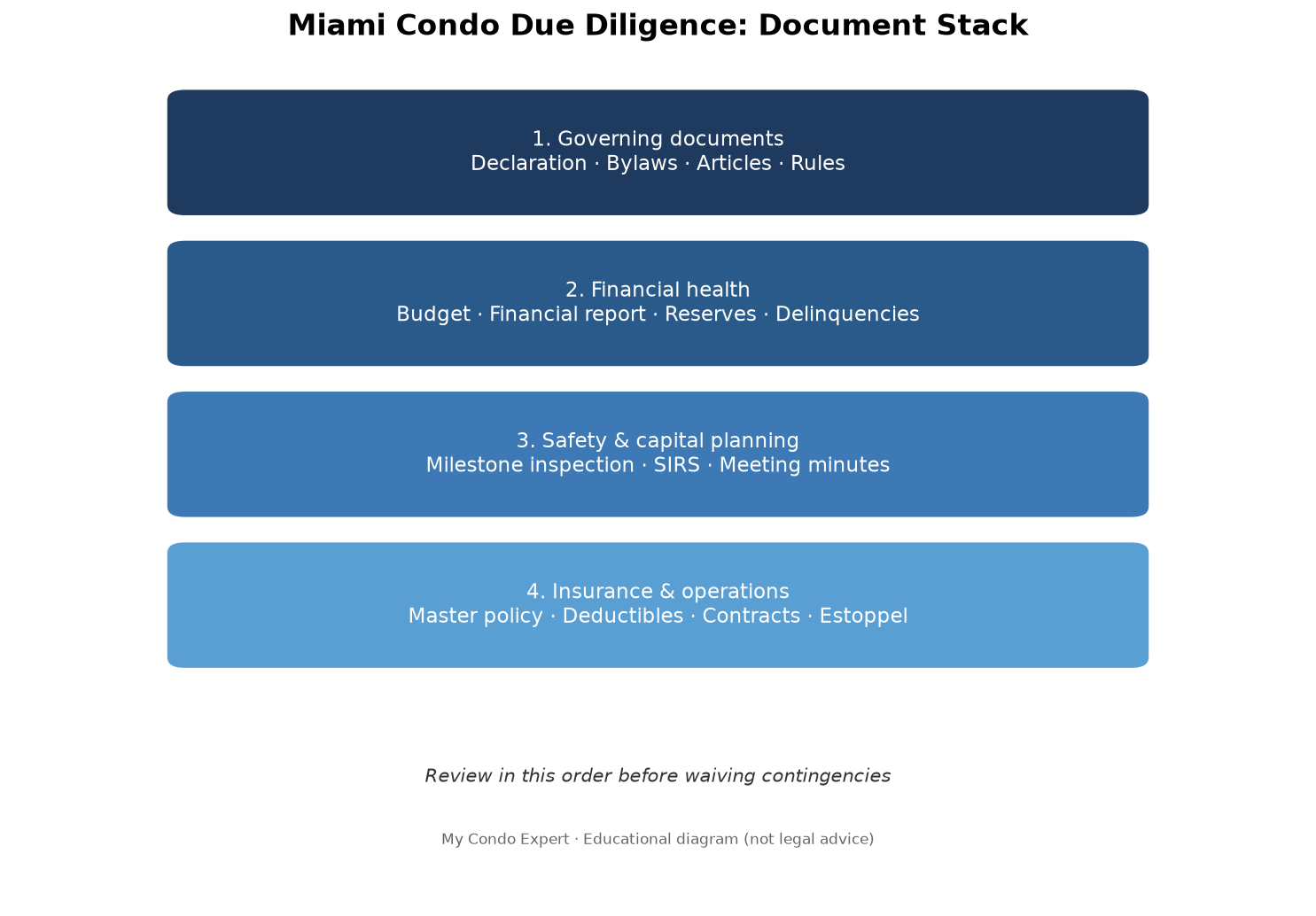
Review documents in this order:
- Governing documents — what you are buying into
- Financial health — what ownership will cost over time
- Safety and capital planning — what the building needs next
- Insurance and closing paperwork — where coverage and seller obligations end
1) Governing documents: declaration, bylaws, articles, and rules
Start here. These documents define the legal framework of the condominium.
Declaration of Condominium
Creates the condominium and describes units, common elements, limited common elements, voting interests, and use restrictions. Pay close attention to:
- Rental restrictions (annual-only leases, minimum lease terms, caps on leased units, application/approval requirements)
- Pet, flooring, renovation, and balcony rules
- Parking and storage assignments
- Any obligations that travel with the unit (for example, assigned boat slips or cabanas)
Bylaws and articles of incorporation
Explain how the association is run: board elections, meetings, budgets, and amendment procedures.
Rules and regulations
Often change more frequently than the declaration. Confirm you are reviewing the current rules, not an outdated packet.
What to ask:
Does this building’s rental and use profile match my plan—primary residence, seasonal use, long-term rental, or (where allowed) shorter-term rental?
2) Financial health: budget, year-end report, reserves, and delinquencies
A low list price is meaningless if the association is underfunded.
Request at least:
- The current annual budget and the prior year’s budget
- The most recent year-end financial report (compiled, reviewed, or audited, depending on association size and revenue)
- Reserve schedules and the latest structural integrity reserve study, if the building is subject to SIRS requirements
- Information on unit owner delinquencies and any special assessments already levied or under discussion
Florida’s Condominium Act requires associations to prepare annual financial reporting and to include reserve planning for capital expenditures and deferred maintenance. For buildings three habitable stories or higher, a structural integrity reserve study is generally required on a recurring cycle, with important compliance deadlines for associations that existed on or before July 1, 2022. See Florida Statutes § 718.112.
What to look for (qualitatively):
- Operating expenses that appear chronically higher than budget without a clear explanation
- Thin or inconsistently funded reserves relative to the building’s age and systems
- A pattern of delaying roofs, waterproofing, elevators, concrete restoration, or facade work
- Rising insurance line items without an accompanying funding plan
Do not invent comfort from marketing materials. If the numbers are unclear, ask the listing side, the property manager, or your attorney for clarification in writing.
3) Safety and capital planning: milestone inspections, SIRS, and minutes
For many Miami buyers—especially in older mid-rise and high-rise buildings—this layer is non-negotiable.
Milestone inspections
Florida requires periodic structural milestone inspections for condominium and cooperative buildings that are three habitable stories or more. Timing is generally tied to the certificate of occupancy (commonly by December 31 of the year the building reaches 30 years of age, with local enforcement agencies able to require an earlier 25-year trigger based on local circumstances such as coastal environmental conditions), then every 10 years thereafter. Phase one is a visual structural assessment; phase two is required if substantial structural deterioration is identified. Associations must distribute inspector-prepared summaries to unit owners. See Florida Statutes § 553.899.
Structural integrity reserve study (SIRS)
Separate from the milestone inspection, a SIRS evaluates major building components (roof, structure, fire protection, plumbing, electrical, waterproofing/exterior painting, windows and exterior doors, and certain other high-cost items) and recommends reserve funding. Official-records rules require associations to retain SIRS materials for extended periods.
Board and owner meeting minutes (typically the last 12–36 months)
Minutes often reveal the truth before an assessment notice arrives: engineer proposals, lawsuit discussions, insurance renewals, contractor bids, and owner debate about projects already underway.
What to ask:
- Has the building completed its required milestone inspection(s)? What were the findings?
- Is a phase two inspection or repair program underway?
- Is the SIRS complete, and does the current budget follow its funding recommendations?
- Are there pending or contemplated special assessments, loans, or lines of credit for capital work?
4) Insurance and closing paperwork: master policy, unit owner coverage, and estoppel
Condo insurance in Florida is a two-layer system.
Association master policy
The association must use its best efforts to maintain adequate property insurance on association property, common elements, and condominium property the association is required to insure. Florida law also addresses what is generally excluded from the master policy and left to the unit owner—such as personal property inside the unit and certain floor, wall, and ceiling coverings, electrical fixtures, appliances, and built-in cabinets located within the unit. See Florida Statutes § 718.111(11).
Your HO-6 (unit owner) policy
Plan on a separate unit-owner policy that covers interior items and liability the master policy does not. Ask for the master policy declarations page early so your insurance agent can identify coverage gaps, wind/hurricane deductibles, and loss-assessment exposure.
Estoppel / association estoppel letter
Before closing, the association (or its agent) typically issues an estoppel stating assessments due, special assessments, and other amounts tied to the unit. Treat discrepancies as a closing-critical issue—not a paperwork footnote.
A practical due diligence checklist
Use this as a working list during your inspection/contingency period:
- Declaration, amendments, bylaws, articles, and current rules
- Frequently asked questions / statutory Q&A sheet, if available
- Current budget + prior-year budget
- Latest year-end financial report
- Reserve schedule and latest SIRS (if applicable)
- Milestone inspection report(s) and any engineer summaries
- Board and membership minutes (at least 12 months; 24–36 preferred)
- Evidence of pending or approved special assessments
- Master insurance declarations page and deductible summary
- Litigation disclosures / notices known to the association
- Rental rules confirmation if investment use is part of the plan
- Application, interview, and transfer-fee requirements
- Estoppel figures reconciled before funding
Resale vs. new construction: same discipline, different paperwork
Resale
You inherit the association’s history. Minutes, inspection reports, reserves, and special-assessment discussions matter immediately.
New construction / developer-controlled associations
You may have fewer years of operating history, but you still need the declaration, budget assumptions, projected reserves, insurance approach, and a clear understanding of what happens after turnover to unit-owner control. Do not skip document review because the building is new.
Common mistakes that cost buyers later
- Falling in love with the unit first, then skimming the docs
- Assuming the regular HOA fee equals the total carrying cost
- Ignoring rental and renovation rules until after deposit
- Treating milestone/SIRS paperwork as optional in older buildings
- Buying without confirming the insurance boundary between master policy and HO-6
- Waiving contingencies before written answers arrive
How My Condo Expert can help
My Condo Expert focuses exclusively on Miami condominiums—within the Cosmore ecosystem alongside related Miami residential brands. We help buyers and investors evaluate buildings, not just listings: spotting document gaps, connecting reserves to upcoming capital work, and coordinating with your attorney and insurance advisor so decisions are based on evidence.
If you are researching a specific Miami condo building or comparing resale versus new construction, contact My Condo Expert for a practical, no-pressure document-review conversation.
This article is for general education only and is not legal, tax, engineering, or insurance advice. Association obligations and buyer protections depend on the building, the contract, and current Florida law.
Sources
- Florida Statutes § 553.899 (Mandatory structural inspections for condominium and cooperative buildings) — https://www.flsenate.gov/Laws/Statutes/2026/553.899
- Florida Statutes § 718.111 (The association; official records; insurance; financial reporting) — https://www.flsenate.gov/Laws/Statutes/2026/718.111
- Florida Statutes § 718.112 (Bylaws; structural integrity reserve study; milestone inspection duties) — https://www.flsenate.gov/Laws/Statutes/2026/718.112
- Florida DBPR — Division of Condominiums, Timeshares, and Mobile Homes FAQs — https://www2.myfloridalicense.com/condominiums-and-cooperatives/faqs/
- My Condo Expert — Special Assessments Guide (related internal page; do not duplicate as a new pillar) — https://mycondoexpert.com/special-assessments-guide/